
Concluding our series on the Charles S. Roberts award winners of 2024, we have the Modern Warfare category, which contains pretty much everything after World War Two. Four games, including the winner, are below, and they cover a broad range of nifty mechanics. As ever, these war games come with small print runs and fluctuating stock, so use that Want List to make sure you’re able to snag a copy.
And you’ll want copies, because these are good games, folks.
The Soviets Falter in Afghanistan
Flying Pig Games has come into its own over the last few years, building on Old School Tactical’s success to develop stellar experiences like Armageddon War and A Most Fearful Sacrifice. ‘85 Afghanistan: Graveyard of Empires continues their propulsive run with a refining of their 2016 title, ‘65 Squad Battles in the Jungles of Vietnam. As you might guess, we’re looking at a squad-level hex-and-counter game here, but with plenty of flair to keep things both exciting and fun. First and foremost, both 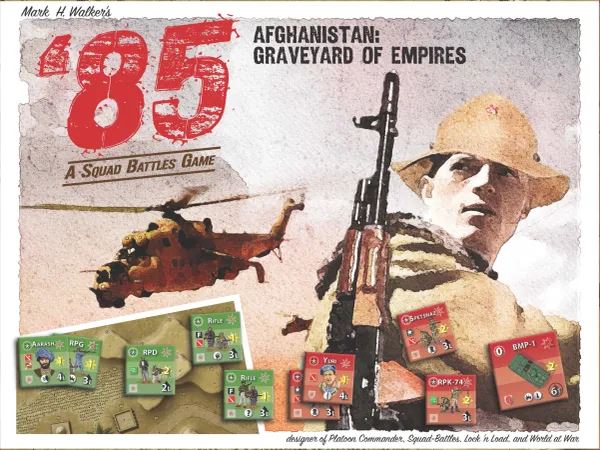 sides, the Soviets and the Afghans, have heroes.
Yes, you read that right, heroes. It’s not Superman and Batman here, but units with unique abilities and personalities that can bend a battle, not break it. We’re talking about boosts to attack values, defense, and a few special abilities, the sort of thing that creates a narrative without becoming an immersion-shattering black hole. You’ll be able to see these heroes doing their thing, too, because, like many of Flying Pig Games’ titles, the counters are big, given great artwork, and get to rush around on huge hexes. If you’re struggling with tiny counters stuffed with numbers, give this one a try – you can set those reading glasses aside.
Actual gameplay bears some resemblance to the Osprey’s Undaunted system in that both players will draw a hand of cards and spend one of them in a blind initiative bid. The rest will be used for alternating activations, with each card offering move, move and fire, or just fire (or, in some cases, reactions with special effects). There’s a nice extra phase after cards have been played that allows units which weren’t activated to do a limited move – this negates some of the stale board states you might otherwise find in games like this, where the same couple of units do all the action and everyone else stands around. The cards, like Combat Commander, do most everything else too, supplying numbers for combat checks and the like. A dice exists, but is really used just for artillery fire.
The cards do a great job of keeping ‘85 Afghanistan’s rules load simple and foster narrative play, as do its scenario designs, which are all about ambushes, convoys, and objective captures rather than plinking bullets at one another. If you’re looking for an easy-to-play squad-level war game, one with vehicles, heroes, and excellent chrome, then ‘85 Afghanistan ought to be next up on your list.
A Solo U.N. Challenge
While solo war gaming, whether by playing both sides or with a true solitaire mode, has existed since the first counter rolled off the press, truly innovative designs seem to be coming more often in this space. SNAFU Design’s Operation Bøllebank continues this trend, putting you in the shoes of a UN commander attempting to/pic8224228.png) get his force through hostile territory without taking casualties or, you know, blowing things up indiscriminately. Those pesky rules of engagement. Anyway, that high bar for success couples with a neat orders mechanic, where units will keep on obeying their last order until you can get them a new one, a potential problem as attacks escalate and communication frays. It’s tense, fun, and plays in under an hour, ideal for lighter solo war games.
get his force through hostile territory without taking casualties or, you know, blowing things up indiscriminately. Those pesky rules of engagement. Anyway, that high bar for success couples with a neat orders mechanic, where units will keep on obeying their last order until you can get them a new one, a potential problem as attacks escalate and communication frays. It’s tense, fun, and plays in under an hour, ideal for lighter solo war games.
That order bit forms the game’s key, as you’ll need to pull chits to issue new orders. Getting the right chit at the right time is a matter of luck and, to a degree, perseverance. As you pull more chits, you’ll be giving the enemy added strength, so it’s vital to think ahead. Because a given order stays in effect, making the right one for a unit can spare you time to handle others, but a messy situation can force a scramble as you try and get the order you need. This mixture is a potent concoction, leading right into “one more turn” play. That it brings you deep into a little-known conflict with fascinating victory conditions is even better.
Elevating Operation Bøllebank from its fellows is the striking graphic design, pulled right from the 1994 conflict where the game is set. Blues, pinks, and a striking board layout meant to reflect actual command screens from the era make Bøllebank a standout. It’s readable, tactile, and well-designed. I’d even say the hardest part of this game, beyond getting a win, might be coming to grips with its layout, just because it’s so different from most other games. But you’ll want to, because this one’s worth trying for any solo gamer (even if you’re new to war games).
Solo Squad Tactics in Vietnam
Calling yourself Tiny Battles Publishing sets a certain size limit, but, as we’ve all heard many times, necessity is the mother of invention. Rifles in the ‘Nam, the fourth game in designer Gottardo Zancani’s RIFLES series, comes in a box, and it is indeed a tiny one. The invention therein, though, is excellent.
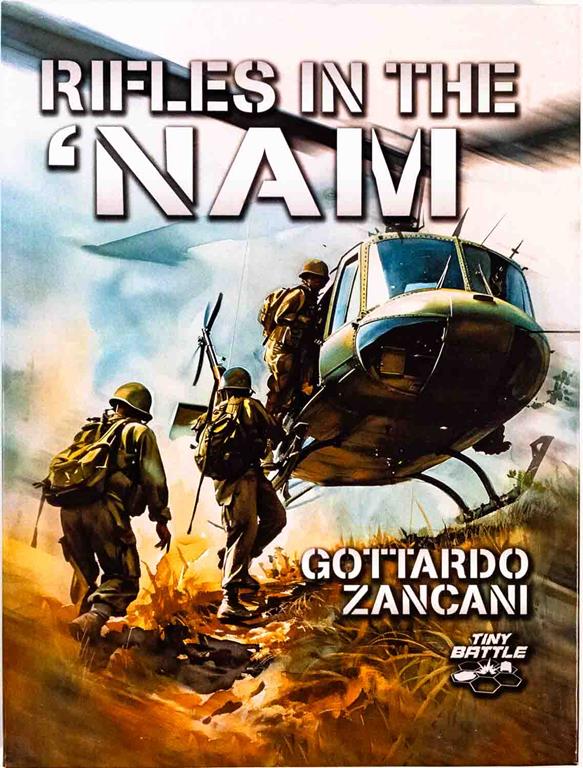 Rifles, like Bøllebank, is a solo game, but its aim is far different from its more modern warfare brother. Rifles prefers dynamism and dice, the latter providing the fuel for a compelling event, attack, and activation engine. In the campaign mode, a clever 48 week venture where a die roll determines whether your squad will get called up for duty, muddle about at base, or, through exhausting marches, suffer fatigue penalties going into their next mission. Once a mission comes up, one of those twelve, you’ll spend points to outfit your squad (gear isn’t free, folks) before sending them out to destroy bridges, seek objectives in tunnels, defend your position at night, and more. The variety here is like a stop at your favorite bakery – it’s all delicious, all easy to dive into, and with enough difference to keep you coming back for more.
With your chosen treat—sorry, mission—at hand, you’ll lay out a small map, place terrain and potential enemies through dice rolls, and decide how you’ll advance your forces. Clumping your marines up into a single death ball makes you vulnerable to ambushes, while spreading too thin, uh, makes you vulnerable to ambushes. Turns out war is hard! Anyway, you’ll move, attack, and deploy equipment through rolled dice at your turn’s start, with the results giving you activation points. Bad rolls mean limited options, random, yes, but realistic: soldiers aren’t always operating at top efficiency. Maybe Bucky’s boots were untied.
Altogether, svelte rules (if you’ve played other RIFLES games, you’ll be able to jump right in), an hour-per-mission length, and the narrative strength of the campaign make Rifles in the ‘Nam a perfect, almost pocket-sized, solo experience. Tiny Battles, indeed.
A Narrative Vietnam War Game Winner
The grim jungles of Vietnam made for a terrible conflict, one that has, over the years, created some of the best war games around. Monsters like Vietnam 1965-1975, CDGs like Hearts & Minds, and squad-based affairs like Fields of Fire and Warfighter. PHALANX, with Purple Haze sets its focus on those squaddies, then uses its setting to elevate the experience beyond chucking dice and shifting counters. Your squad is more than numbers and attributes here – they have names, they’ll make choices, and, in a stellar campaign, those choices will make all the difference.
In Purple Haze, you’ll embark on a mission with your 6 marines, moving through the jungle as the clock ticks. Encounters and narrative beats will pop up, where you’ll read a (brief) beat and make a choice. Say, do you follow a trail that might be an enemy squad setting an ambush, or ignore and press on towards your main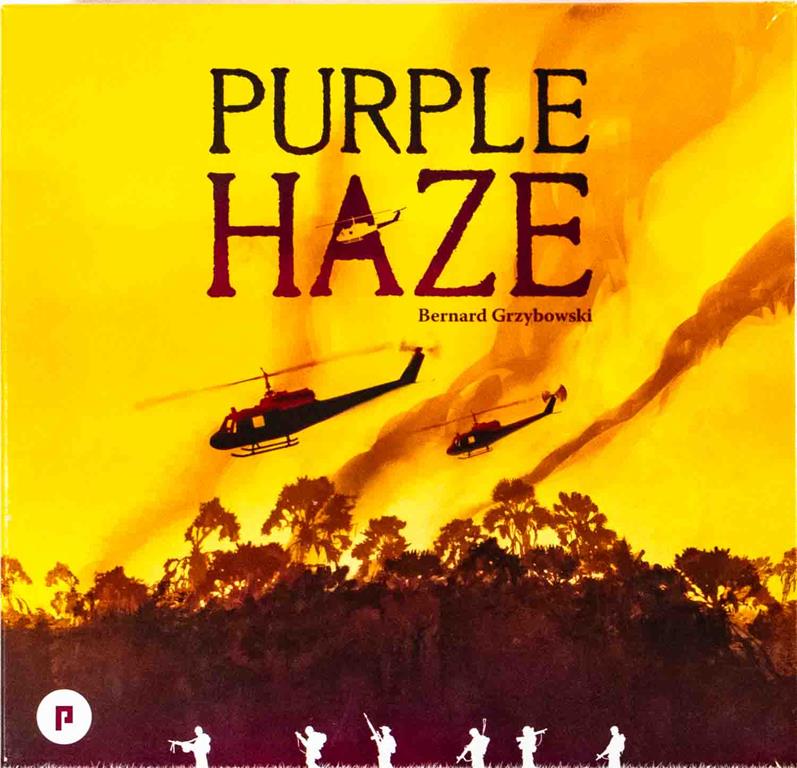 objective? Do you send a marine to scout or fortify, expecting an assault? These choices have real impact, changing how the battles play, and what enemies you confront. The variety here makes the campaign easy to replay, especially when you factor in the differences your soldiers can have, from traits to equipment. Maybe on play one you dart after that ambush and find out it was just a villager leading some livestock, but the delay lets you ambush the would-be ambushers. On the second one, you don’t, but pressing on puts you at the objective right on time for a devastating assault. Different outcomes, different battles.
Those battles play out on a tactical map which’ll change based on the choices you’ve made to get there. It’s a smallish batch of hexes that’ll fill up quickly with units, terrain, and, soon, the sound of gunfire. Your load-out has a massive impact on how a marine will play, as will the simple chit-pull and dice rolling enemy activations. The rules here are not extensive—the large rulebook is stuffed with examples, inflating its size in a good way—and the battle gameplay is smooth, often tweaked with objectives beyond the usual ‘kill them all’. Once a skirmish ends, you’re up against that clock again: rest and recover, giving the enemy the same chance, or press on to try and complete the mission (or, in a neat twist, call for an evac, to keep your squad alive).
All in all, Purple Haze delivers an immersive tactical experience buttressed by meaningful narrative. The base game is a great start, with optional expansions to add more characters and missions. While it’s easy to recommend as a solo game, it plays fine at two or three as a cooperative campaign (you split up the marines) with its two hour sessions. Bold, with a quality PHALANX production, it’s no surprise Purple Haze wins this category. If you’re looking for a tactical adventure in Vietnam, you’ll be hard-pressed to find one as good and as accessible as this one.


