
Hexagons, dice, pastoral artwork, and… a robber? CATAN, originally The Settlers of Catan (so says my well-worn box), has been making euro magic for over 30 years. Expansions, alternative versions into the stars and over the oceans, and even a gigantic 3D edition have all graced our tabletops. For those hungry to put that experience into competitive arenas, the CATAN Championships have been running since 2002, and now a qualifier for the next of these biennial events is coming to your friendly game store, Noble Knight, on May 23rd (a Saturday).
If this is right up your alley, go ahead and register here – and if you’re on the fence, or just want to know what it’s like to play in a board game tournament, read on.
What are CATAN Local and Regional Qualifiers?
The CATAN Championships start with a worldwide structure, encouraging the best players in a world divided up into regions to play their sheep, build their 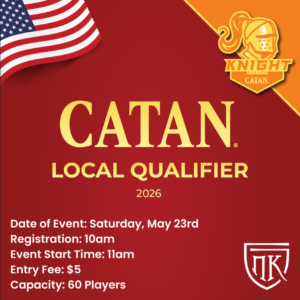 cities, and score more victory points in tight competition with one another. The two-year world championship cycle begins with a host of local and regional qualifiers, with victors there getting invited to their country or larger region’s championship – the US, for example, has a 16-player national championship. Win or place near the top there and you’ll have a shot to get sent to the next level, which means, in the Western Hemisphere, the Americas Championship, and then the World Championships.
Starting at the bottom rung of this euro ladder are the local or store qualifiers. These, as you’d imagine, bring in players from the area to play between 4 and 6 games, using wins and relative victory points (explained below – tis arcane stuff) to determine the eventual victor. Emerge on top here and, in addition to other prizes – which trickle down to other places too – you’ll earn a trip to regionals.
Regionals are, as you’d expect, bigger affairs. These big territory swaths are defined by country. The US is split into three – Merchant (West Coast), Knight (Midwest), and Pirate (East Coast). You can, technically, qualify for multiple regionals by winning local championships in separate regions if you’re a CATAN devotee, but should you play in multiple regionals, you can only win one national championship seat. Did I need to type all that out? Who knows, but I found it fascinating that there’s enough players willing to traverse their country, to play in multiple store championships, and attempt to win multiple regionals, that we needed special rules for it.
That’s rad.
Anyway. The top four placers at each regional (a stricter 4 game affair, though the cutting rules apply to keep competitive balance) get tickets to the National Championship. So far, so good – but wait! Let’s say you’ve done all this before, cruised to the National Championship and put on a show. You might also get an invite to the Masters Invitational, a neat bonus tournament for past top-placing Nationals players. The top four here also get their tickets punched to that year’s Nationals.
As mentioned above, the National Championships are a 16-player tournament, with the victor getting to represent the US (or your local country) at a cross-national championship like the Americas Tournament (the most recent one was held in Brazil this past March) and the World Championship held every other year. In other words, get to the top and you’ll be part of a pretty special, unique group.
What to Know About CATAN Qualifiers
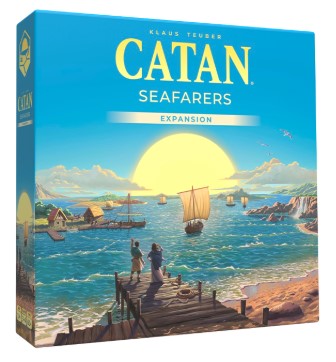
If you know CATAN, then you’ll know there’s (approximately) one billion expansions and variants. Cities and Knights, Seafarers, King of Tokyo, etc. When we’re talking CATAN tournament play, though, there’s a distinct lack of kaiju. Instead, you’re playing base CATAN. Longest Road, robber on rolled 7s, and taking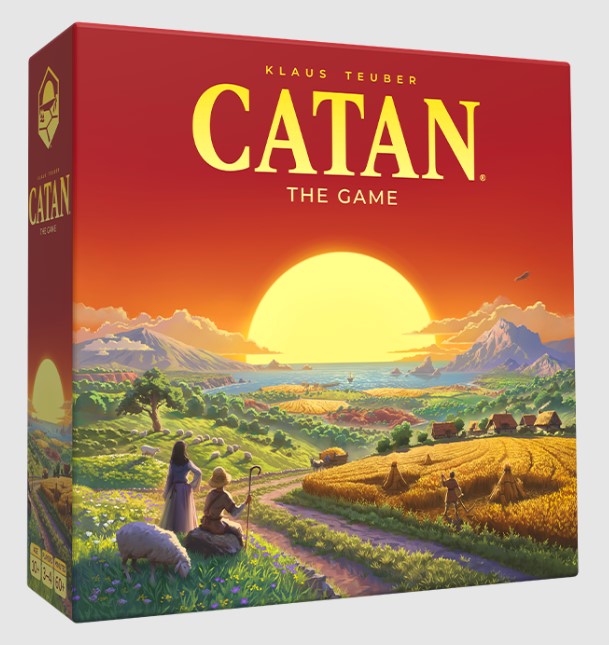 territory with strategic settlement placement. There’s a purity here, a lack of fluff, but if your CATAN game depends on a soufflé of combined expansion content, then you’ll want to practice with stripped down sessions.
On game day, you’ll get grouped at random into tables of four, eventually winnowed down after 3 games in a semifinals cut so those that won prior rounds go up against one another. Usual game tournament etiquette applies – there’ll be judges to help answer questions, but being genial, knowing the game rules, and prepping yourself for several hours of play is key. Water bottles, any medications you might need, and snacks (Noble Knight now has a good supply of the latter!) are a must, because vanishing in the middle of a round is, you know, frowned upon.
When the games get going, you’ll set the board and reveal the map, which is set up by the tournament organizers and is the same for all games in that round, getting 5 minutes of study time. From there, the player with the ‘highest ranking’ in the tournament gets two minutes to pick a color and their player order (e.g. 1, 2, 3, or 4). Progression continues until everyone’s picked their position and preferred color, then we get to the meat of things. Depending on the number of players and desire to keep things on schedule, you might see timers used, generally aiming for a move every minute or two. When a tournament’s packed with plenty of games to play, this sort of thing’s important, so if you’re prone to analysis paralysis with CATAN, it might be worth practicing at speed.
What’s more fascinating is the end game – you might be wondering how, if every winner in a CATAN game scores 10 VPs, there’s a ranking difference between 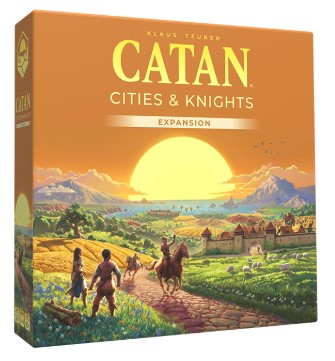 winners. It’s actually a bit like college sports, where the domination of the opposition is taken into account. Let’s say Player A wins with 10 VPs, and the other three each score five. That puts a total of 25 VPs in the game, and our winner scored 40% of those. In another game, Player B won with 10, but the other three each scored 8. Player B only had around 30% of the total points scored, putting his rank a little lower than Player A. There’s a bit more math involved as the tournament goes along, but that’s the gist – higher ranks tend to win before their opponents get a chance to score.
From a gameplay perspective, there’s also a few interesting wrinkles called out:
- No free lunch – While I personally haven’t seen this in my games of CATAN, the opportunity exists to just give another player a card or resource for nothing in return. On its face, that seems odd, but the examples offered in the rules linked below include multi-step trades that essentially prohibit including additional resources as incentive. Like, say, trading a player 3 resources to get under the cap before their turn, and then, after that roll, only taking one or two
 of those resources back. That player essentially earned a resource for nothing to facilitate the trade, and that, as they say, isn’t fair.
 - No collusion – Another somewhat blurry rule, as it’s hard to distinguish intent from poor play, but you can’t directly give another player an advantage. Note that you can work together with another player for mutual benefit – the key here being that you also gain from the action. Like, say, consistently trading with one player over others to give you two an edge. It’s, ya know, poor sportsmanship, but technically within bounds.
- No trades before rolling the dice – when your turn starts, you can declare victory or play a development card, but can’t take other actions. Same for handling the results of the die roll – all resources must be parceled out (or robber handled) before new deals can be struck, with a single exception: you can bargain for where to place the robber.
- Lastly, if either die is cocked or otherwise obscured after the roll, the player must re-roll both dice.
If you’re planning to attend, it’s also worth looking at the full tournament rules here.
Ultimately, even if you’re a relative Catan novice, these sorts of events are worth attending just for the organized play experience. Prizes abound, and getting to see how top-tier players approach these games can help you grow as a player, and illuminate the dimensions to a classic title you might not have seen before. For the $5 entry, you’re getting at least 3 games – that’s a lot of roads, bricks, and fun to be had.


