
As you may have heard, a new rendition of Homer’s The Odyssey arrives this summer courtesy of Batman savant Christopher Nolan. The ancient story, suffused with adventure, gods, and monsters, is both fertile ground for fiction and, as you might’ve guessed, board games. Today we’re taking a look at several titles running the mythological gamut, from area control to vast, well, odysseys.
So grab a good amphora of wine, toss a prayer to Zeus, and let’s get to the games.
Iliad and Ichor
We start with the appetizer, two fun, light, but nevertheless tactical games by the prolific Dr. Reiner Knizia and published last year by Bitewing Games. Both play in around a half-hour, with gorgeous productions—a Bitewing staple. If you’re a Knizia fan, these will fit right in with much of his two player oeuvre, but which one, or both, to acquire depends on your tastes.
Ichor is an area-control duel, where each player assembles their army of gods and monsters and sends them zipping across a grid. Every turn you can move one of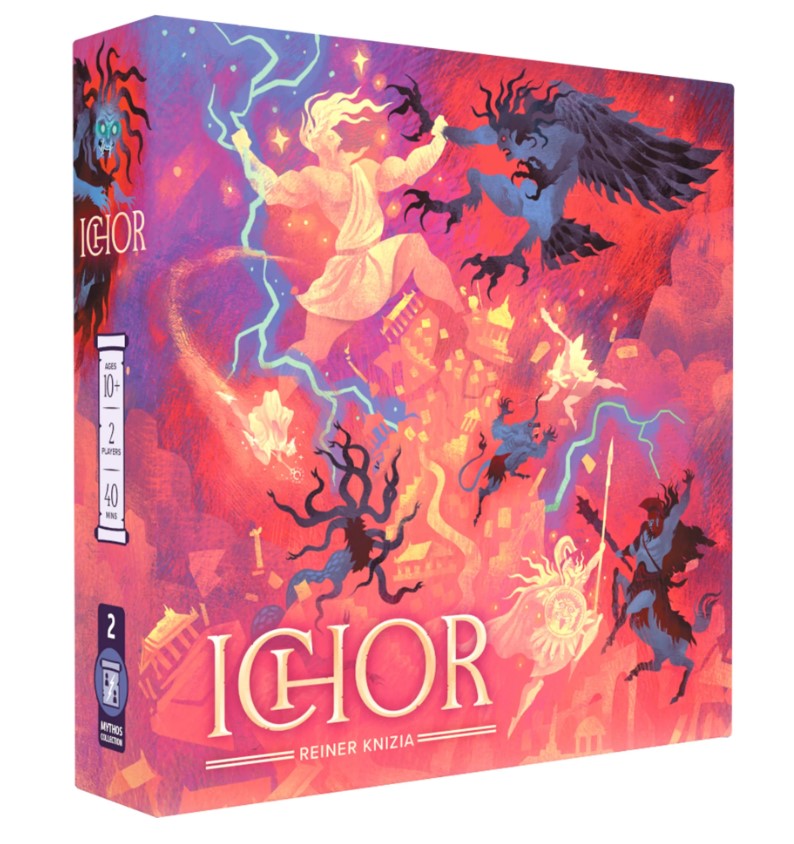 your figures as far as you like in a straight line, leaving one of your markers on every piece they pass. However, they cannot pass through another figure or the board edge, though they can steal spots from the opponent. Place all of your tokens onto the board and you win. So simple, so like many other games.
What sets Ichor apart though are those gods and monsters. Each one grants you one game-changing ability per, well, game. Time their uses right to set up big plays or block your opponent, and now you have a much more tactical dance. Can you tease out a big swing with a ready counter, or will you wait too long to set up your strike and let your opponent win? Ichor includes a more advanced mode too, with more creatures, gates to keep units skipping, and plenty of replayability. Like so many Knizia titles, Ichor starts with a simple premise that unfolds into so much juicy depth.
Iliad likewise serves up tactical tension. Simulating the battle between Hector and Achilles, Iliad has each player setting tokens next to each other on a square grid. Each token is worth a certain amount of strength from 1-5 and a unique ability, plus a special copy token, and both sides have the same arsenal. The trick comes in completing rows and columns, as each offers points and the support of a god. Victory comes through total points or support of all five gods, and be aware that some gods will cost you points. Thus, not only are you dancing with your opponent, you’ll likely need to choose between chasing deities or simply winning on score. It’s a devious small-box duel, perfect for any spot or evening.
Mythic Battles Pantheon
Mythic Battles, as its name suggests, is very much not a small box. It is, depending on how much battling you want to do, perhaps the most opposite of a small box title (excepting, say, Warhammer). A skirmish game, where players pit teams of gods, monsters, and unfortunate soldiers against one another in dice-driven combat, Mythic Battles – and here, we’re talking specifically Mythic Battles: Pantheon – is the sort of spectacle a game of divine warfare deserves.
Pantheon delivers the Greek goods. Your gods are in there, ready to wreak havoc, and so is Odysseus himself in a literal appearance (and quite a strong one too –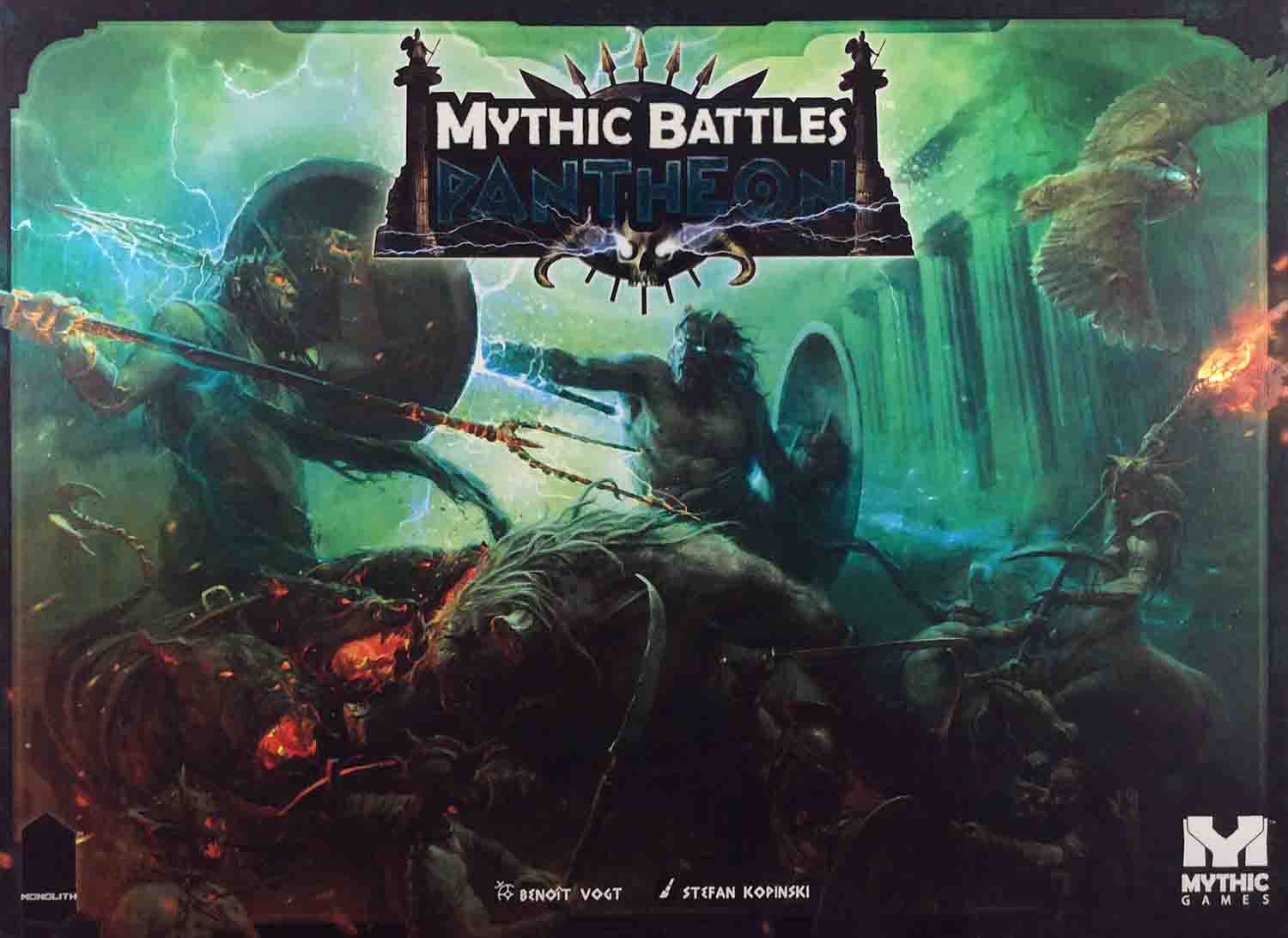 his abilities are stellar). You’ll either draft or randomly assemble a squad from your collection, with each unit getting its own data card and adding its unique playing cards to your deck. That deck drives your game, as almost every card (save unique, flexible Art of War cards that activate special abilities) is tied to one of your units. On your turn, you’ll play them, each one activating that unit to deploy it, have it scamper about the map, or collect some vital omphalos, which grants you a bonus card and is one way to win.
The other way, naturally, is to destroy your opponent’s god. Each of you get one of these divine lords for free, and their physical manifestation on the battlefield is both a weakness and a strength. Do you send Zeus into the fray, letting him lightning bolt everyone but opening him up to wounds? Or hang back and hope your lesser troops can carry the day? It’s often best to play your hand and, ultimately, sling some exploding dice at the enemy.
Mythic Battles sits nicely between the beer-and-pretzel and rules-heavy edges of miniatures war gaming. Matches take an hour once you’re up and running, with unit drafting becoming a compelling chess match the more you play. Newbies can fumble their way to spectacular moments—a Hades and Apollo team-up to beat a titan? Yessir. I’d suggest starting with a core box of your chosen mythology (Norse is out and Egypt is coming), then adding more as you want variety. There’s also campaigns, painting guides (these minis come assembled), and so much more – if you’d like to ground your dueling in mythology, it’s hard to think of a better choice.
Lords of Hellas
For those who prefer their Greek epics zoomed out, Lords of Hellas presents a sprawling area-control venture set across ancient Greece. You’ll again find yourself 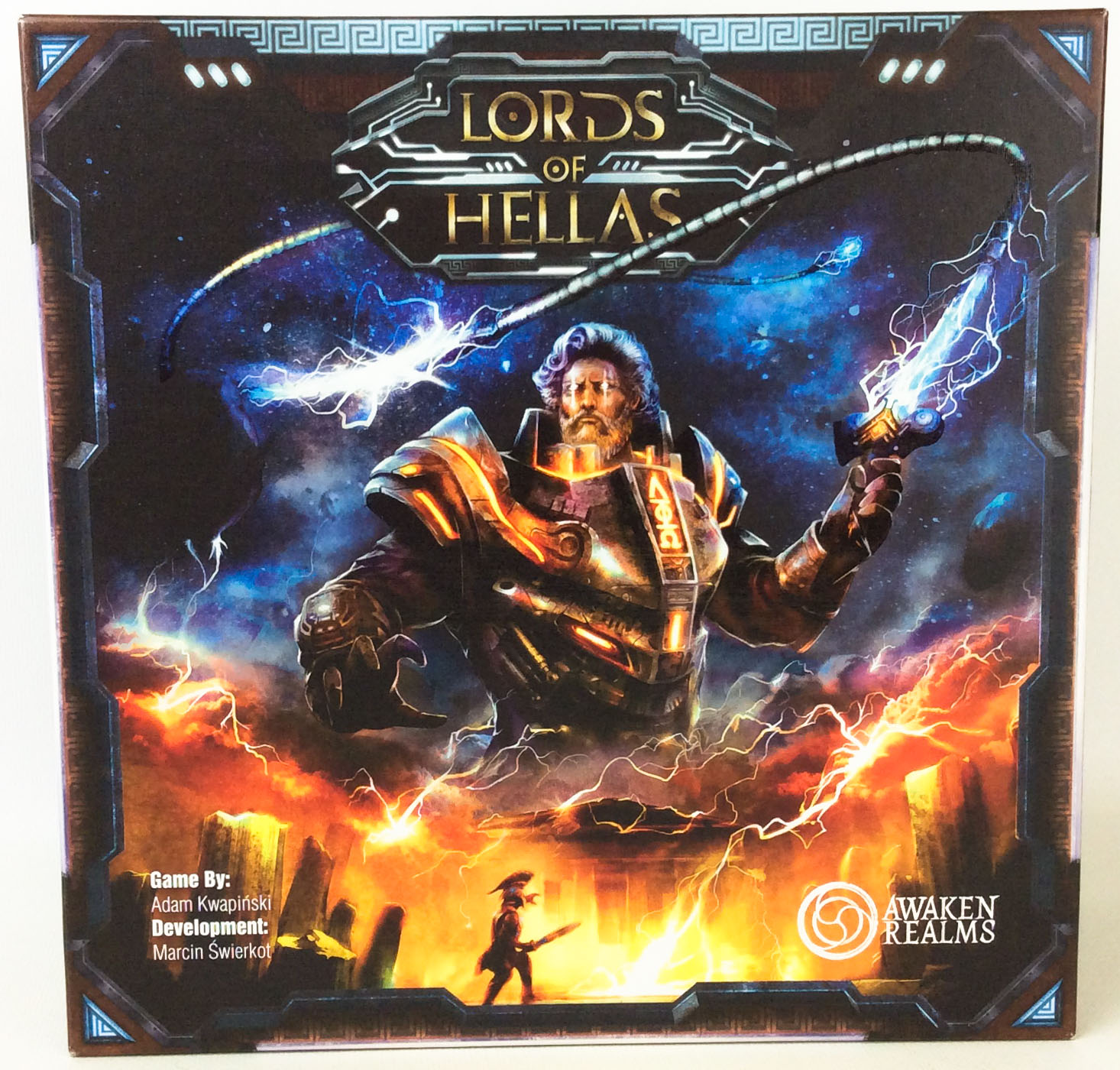 an ancient hero commanding troops in search of a win condition – slay enough monsters, hold enough temples, or rule enough territory. Along the way you’ll upgrade your hero’s attributes through artifacts or some god’s favor (probably Hades, you evil monster, you).
The asymmetry and thematic punch elevates Hellas to similar status as its neighbors Kemet and Cyclades, but there’s plenty of gameplay differences too. Hellas puts all the onus on its players, with actions getting used up as you do them, only to be reset for everyone when one player decides to do so. That simple switch has astounding implications for turn efficiency – do you try to avoid resetting for as long as possible? What if someone does so again quickly, to repeat a core ability? It’s a fascinating dynamic that shifts the usual ‘you only have so many actions per round’ efficiency optimization seen in similar titles.
Hellas couples that dance with an intriguing, card-driven combat system that asks you to gauge where you want to spend your soldiers and your best cards. You could spring a trap against a stronger force, but doing so might mean letting lesser battles go against you. Surprises are everywhere, and fighting is often a tense tactical web. Hunts, where a player attempts to slay a beast, who is then controlled by another player, are faster but no less fun (and can be equally brutal for the loser).
Lords of Hellas is otherwise an Awaken Realms title through-and-through – decked out in glorious components, stuffed with miniatures and extras. A showstopper presentation backed up by quality gameplay. Hellas will bring people to the table, and your odyssey, then, will be seeing them crushed beneath your sandaled heel.
Aeon Trespass: Odyssey
There are doubtless readers who knew this title had to be here – we’ve mentioned Aeon Trespass: Odyssey before, and yet, we must again. For cooperative campaign players with heavier tastes, it’s excellent, gigantic, deep, and has more expansions on the way, though its five core cycles will devour years of your gaming life on their own. Its publisher, Into the Unknown, has grown from this title into a hobbyist darling, producing not just Odyssey but the similarly gargantuan and unique Kingdoms Forlorn. In short, these are special experiences crafted with care, built for players ready for a journey not far apart from what Odysseus went through himself.
Minus, you know, all the physical toil. This is still dice and cardboard, folks.
Aeon Trespass is, abstracted, a cooperative, narrative boss battler. You are tasked with leading a crew of post-apocalyptic Argonauts in a techno-Greek world where/pic4874391.jpg) the gods have largely vanished after a cataclysm. Using a giant ship and similarly monstrous Titans—think the machines in Pacific Rim—your Argonauts travel this torn world solving mysteries, siding with or against factions, and doing battle with a bevy of strange, terrifying, and sometimes straight-up confounding creatures. Sessions might span hours of compelling, choice-driven story or burn with one battle after another. Loot, character evolution, technology, and much more have their place.
the gods have largely vanished after a cataclysm. Using a giant ship and similarly monstrous Titans—think the machines in Pacific Rim—your Argonauts travel this torn world solving mysteries, siding with or against factions, and doing battle with a bevy of strange, terrifying, and sometimes straight-up confounding creatures. Sessions might span hours of compelling, choice-driven story or burn with one battle after another. Loot, character evolution, technology, and much more have their place.
All of this, too, requires complex rules and time. Keywords and icons abound. Like a monster war game, Aeon Trespass rewards consistent play with smoother flow. The action and day-by-day steps come easier when you’re not taking weeks between sessions. It’ll also make you appreciate your gaming table, as setting this adventure up every time is a task worthy of Hercules. But when you get there, you’ll find a singular achievement in tabletop gaming, one that carves out its unique place as a crowning piece in any collection or tabletop experience. I’d suggest playing at two, unless you plan to, say, sail on a ship for a very, very long time and can guarantee the same players are available night after night.
Do that, and much like Odysseus, you’ll reach the end with quite a different view of what our hobby is capable of.


